

For many applications, there is a faster and more efficient option: waterless tank scale calibration.
Instead of filling the vessel with water or another material, a waterless calibration system uses calibrated reference load cells and hydraulic force to apply a known load to the tank scale. Depending on the application and site conditions, the calibration service can often be completed in around two hours, minimizing downtime while providing the reference measurements needed to calibrate the scale.
How Are Tank Scales Traditionally Calibrated?
Two common methods are test weight calibration and flowmeter calibration.
With test weight calibration, known weights are applied to the tank scale. While the concept is straightforward, the logistics may not be. The weights must be transported to the tank and there must be adequate space to position or hang them. The tank must be structurally capable of supporting the applied weights, and brackets may need to be welded to the vessel. Handling the weights also creates additional safety considerations.
With flowmeter calibration, the tank is filled with material measured through a calibrated flowmeter. This requires a certified flowmeter suitable for the material, a supply of calibration material and time to fill the tank to the desired weight. If an error occurs, the tank may need to be emptied before the zero value can be captured again. Introducing material for calibration also creates the possibility of contamination.
Waterless calibration is designed to avoid many of these challenges.
How Does a Waterless Calibration System Work?
A waterless calibration system creates a controlled load without requiring the tank to be filled.
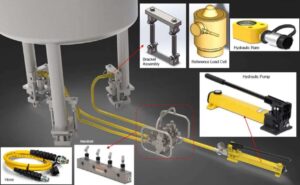

Calibrated reference load cells are positioned at the tank’s load cell mounting points, with hydraulic rams installed as part of the setup. The hydraulic hoses are connected to a distribution manifold and hydraulic pump, while the reference load cells are connected to a calibrated digital weight indicator.
When the hydraulic system is pressurized, the rams generate downward force on the reference load cells and the tank load cells. This creates a known reference load without adding water, product or traditional test weights to the vessel.
Technicians then compare the tank scale’s digital weight reading with the calibrated reference indicator. The tank scale is calibrated so its indicated value matches the reference value.
The system can be used with both standing and hanging tanks.
What Are the Advantages of Waterless Tank Scale Calibration?
One of the most significant advantages is time. Minebea Intec reports that its waterless calibration system can perform calibration up to three times faster than a flowmeter calibration.
For many applications, our calibration service can be completed in approximately under two hours, although actual calibration time will depend on the tank, installation and site conditions.
The benefits go beyond speed. Waterless calibration can also:
- Reduce downtime by eliminating the lengthy process of filling and emptying a tank solely for calibration.
- Require less manpower than traditional calibration methods.
- Eliminate calibration material costs because water or other material is not needed to establish the load.
- Generate no material waste from the calibration process.
- Reduce contamination concerns because calibration material does not need to be introduced into the vessel.
- Avoid tank modifications for test weights, such as adding brackets to hang weights.
- Reduce manual handling risks associated with transporting and positioning heavy test weights.
When Does Waterless Calibration Make Sense?
Waterless calibration can be particularly valuable when traditional calibration would be difficult, expensive or disruptive.
For example, consider a tank that would normally need to be filled with thousands of pounds of material simply to perform a calibration. That material has to come from somewhere, be transferred into the vessel and then be removed or otherwise handled afterward.
Similarly, using test weights may be impractical when there is limited space around the tank or when applying enough physical weight to reach the desired calibration value is difficult. These are among the limitations identified with traditional test-weight calibration.
A waterless system instead applies a measurable hydraulic force directly through the calibration setup. That can make the entire process considerably simpler.
Can Waterless Calibration Reduce Production Downtime?
For facilities where tanks are part of an active production process, calibration isn’t just a metrology issue. The amount of time the equipment is unavailable matters, too.
A calibration method that can often be completed in around two hours can help reduce the disruption associated with taking a tank out of service. There is no waiting for a vessel to slowly fill to the required calibration weight, and no calibration material to empty afterward.
That combination of speed and reduced logistics is one of the biggest practical advantages of waterless tank scale calibration.
Is Waterless Tank Scale Calibration Right for Your Application?
The appropriate calibration method depends on the tank scale, installation and application. Test weights and flowmeter calibration remain established methods, but they aren’t always the most efficient choice.
For suitable applications, waterless calibration offers an alternative that can reduce calibration time, labor, material requirements, waste and contamination concerns while avoiding the challenges associated with handling large test weights.
Need to calibrate a tank scale? Contact our The Scale People/Lab People calibration team to discuss your application and determine whether waterless tank scale calibration is an option for your equipment.